
Abundance is Not “Moderate” or “Progressive”
It’s radical

The country that sent a man to the moon cannot complete a single modern high-speed rail line. The birthplace of the lightbulb struggles to modernize its electrical grid. In the land of the free, getting permission to build an apartment can take longer than growing a human being—or two or three of them.
An ambitious policy framework, called “abundance,” can help solve these disparate problems. Yet a new-ish Vox article is the latest attempt to classify abundance as a moderate political program pushed by a decrepit political elite.1
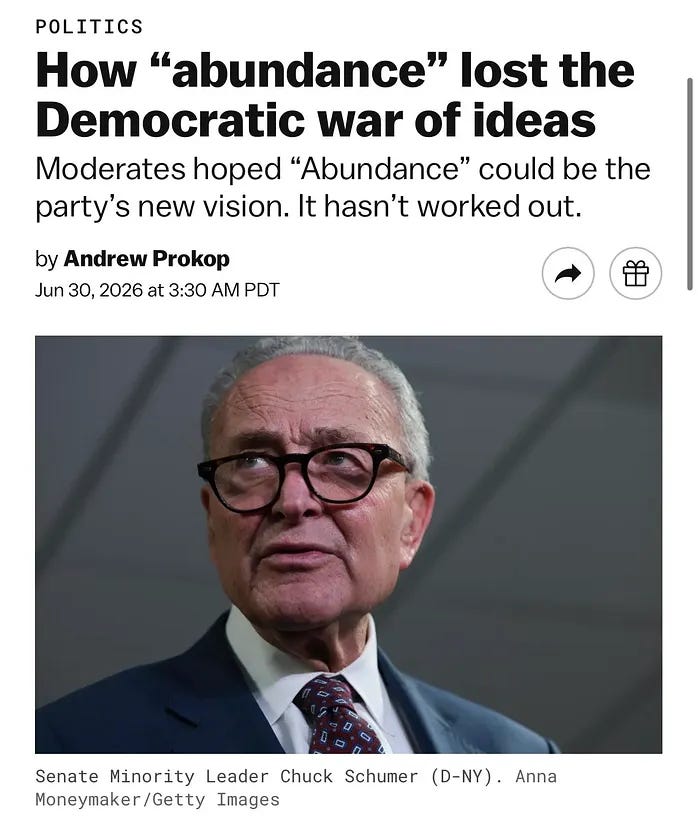
The narrative makes no sense for three main reasons:
Abundance is actually a radical platform that offers solutions for every faction of the Democratic Party.
Both self-described “progressives” and “moderates” are adopting abundance-inflected policies (and also challenging them).
Abundance policies increasingly win at every level of government—though they still face strong headwinds and a long road to political success.
The ideas underlying abundance can help every part of the Democratic Party (and the Republican Party too!) be better at actually delivering results on essential issues. They represent a dramatic break from our status quo political quagmires.
Abundance is radical
There’s nothing moderate about wanting to rewrite a century of federal, state, and local land use policy to 10x the rate of housing construction. Or break the licensing cartels used by doctors and other white-collar professions to push up costs for everyday consumers. Or expand America’s transportation system by building thousands of miles of high-speed rail. Or transform our energy grid with tons of new clean energy and infrastructure. Across many issue areas, abundance calls for big changes.
In our polarized politics, ideas that represent a huge shift from the status quo get framed as “moderate” because they sometimes involve private markets rather than state intervention. But exclusionary zoning and doctor cartels and freeway-obsessed planning don’t fit on the moderate-progressive spectrum, or even the left-right spectrum. Sometimes solutions to these problems involve changing regulations, yes, but they also often involve increasing state capacity to do big things.
While Abundance may be radical relative to our status quo, it also harkens back to tradition. Per fellow Substacker LastBlueDog, “Abundance basically just posits an America where you can do stuff without facing 45 layers of veto power. That’s not a radical vision! It’s the most classically American vision possible for how society should function.”
I partly agree: Abundance certainly embraces individual agency. It also imagines an effective state capable of building major infrastructure and delivering high-quality services. Both are part of the American heritage, a country that once built more things than anywhere else but also revolutionized healthcare by setting up Medicaid in five months. Abundance is nuanced, radical and traditional simultaneously.
Interlude: What I mean when I say “Abundance”
In 2025, a couple of journalists who need not be named wrote a book called “Abundance.” The book has become the branding term for a much broader set of ideas, ideas for which those journalists are not the most significant intellectuals or prime movers.2
One way to describe abundance’s underlying principles is:
People are good and we should want to improve their lives.3
An important part of improving peoples’ lives is improving their material conditions—including their access to high-quality housing, childcare, transportation, healthcare, energy, and other necessities, at an affordable price.
Part of improving peoples’ material conditions involves creating more of the things people need. And creating those things requires building state capacity to deliver high quality infrastructure and services; rightsizing regulations so that people have the freedom to live their best lives; and reducing rent-seeking behavior so infrastructure and services can be delivered at reasonable cost.
I’d add a principle 3.5, that improving material conditions complements other objectives across the political spectrum like reducing climate change (such as by building a bunch of clean energy), strengthening national security (such as by building ships, planes, and computer chips), promoting equitable access to education and opportunity (such as by allowing more childcare operators and workers), and more.
Combined, these concepts form a general framework that can be applied to a variety of problems caused in part by not having enough things. Housing would be broadly more affordable if we built more housing, so we should remove barriers to and provide incentives for building housing. Urban Americans would be able to travel for work and leisure more easily if we had high-quality public transit, so we should change the way we build transit. Healthcare would be more accessible if we had more doctors and lower-cost medicines, so we should create more spaces at medical schools and reform bad health insurance payout incentives that drive up costs.
Abundance thinking is more a toolkit than an ideology, so it also doesn’t offer answers to issues like foreign policy in Gaza and Israel, disagreements about social issues like trans rights, or the right level of taxation to fund social services. Even in the issue areas on which it focuses, abundance doesn’t solve everything so much as the portion of any problem that derives from lack of supply or bad governance. Some Dem pundits and politicos reject abundance entirely because it doesn’t answer distributional questions: For example, how do we ensure everyone can access high-quality housing once we build it or decent healthcare when the medicines exist?
Yet abundance asserts that the world can be positive sum. Solving questions of distribution gets easier when there are more things to distribute. And providing redistribution programs like food stamps or low-income housing or single-payer healthcare requires a government that can operate efficiently and quickly—the state capacity component of abundance.
As a whole, because of its openness to both effective governance and private markets, abundance is different from the dominant intellectual currents of all of the groups within both political parties. Nobody “owns” abundance yet, so the framework remains unpolarized. Which in part explains why the ideas have been increasingly adopted.
Abundance helps many factions and parties
In real-world politics, abundance is already breaking through political polarization. Self-described progressive NYC mayor Zohran Mamdani worked with moderate New York Governor Kathy Hochul to reform environmental laws that blocked sustainable housing and transit development. Controversial Democratic California State Senator Scott Wiener passed the state’s biggest upzoning in history with supportive votes across factional and party lines (also opposition across those lines).
It’s not just Dems who benefit from abundance—or who sometimes fight over it. Most famously, some Republican states have embraced major zoning and permitting reforms to build more housing; they have accordingly seen construction booms that moderate home price and rent inflation even as their populations grow faster than those of Democratic states. Meanwhile, the abundance-inflected federal ROAD to Housing Act recently passed into law without Trump signing it, and almost all of the “no” votes came from Republican legislators.4 Abundance remains controversial within both parties.
Though it’s good for governing, “abundance” is mediocre politics.5 Issues like energy permitting reform or medical licensing reform or scientific review board reform might bring down costs long term, but they don’t offer immediate solutions for the day-to-day concerns of most Americans, or the cultural issues that have high salience in politics. To refer back to a current Dem favorite, Zohran Mamdani in New York City is politically successful because he speaks to New Yorkers’ core concerns about reducing cost of living and improving services. Abundance branding has nothing to do with it.
But Mamdani has governed decently in his first year and a half because he cares about things like building housing and speeding up buses and filling potholes quickly. All very abundance-y things. The toolkit offers real solutions to the cost of living issues Mamdani (and most sane politicians) cares about.
Abundance is winning quickly in political time
Though abundance may not be the dominant framing in most elections, it has received more high-level buy-in than most new conceptual brands. The bipartisan congressional Build America caucus, formed last year, explicitly refers to itself as the “Abundance Caucus.” More than 40 congresspeople have joined. In reforms to environmental laws last year, California Governor Newsom embraced permit streamlining not only for housing, but also for energy, transportation, and some high-tech manufacturing—and shouted out abundance in doing so. The aforementioned ROAD to Housing Act bundled over a dozen meaningful housing reforms into a single package, an amazing accomplishment amid a deadlocked Congress.
The most politically developed abundance-y movement, YIMBYism, is barely a decade old, yet it has already passed legislation in states across the country. Like “abundance,” the “Yes In My BackYard” YIMBY movement labels itself with a tacky slogan. Such slogans seem cheesy, but they can become a component of our identities (i.e. a feminist, an environmentalist, a YIMBY… an abundant?).
I’m fired up about abundance because so many pundits and activists say it has already failed. Meanwhile, people are building its ideas from white papers into organizations, from organizations to political influence, from influence to law. Politicians across the aisle are adopting its tenets. Their strategies vary, their ultimate effectiveness remains to be seen. But their framework clearly has momentum, influencing congressional leaders, state legislators, governors—the decision makers who matter most. They may yet rewire American politics with new coalitions and political possibilities.
Author’s note: Thank you to everyone who liked, commented, or re-stacked my original note message testing this concept. You comments, conversation, and especially criticism helped me develop the content of this article.
For more abundance bashing, see The American Conservative claim Democratic elites like abundance but rank and file hate it (surprise surprise, conservative media doesn’t understand Dem Party internal politics). Very lefty Current Affairs asks everyone to Abandon Abundance. The Revolving Door Project put out a report “debunking” abundance. Countless Substackers have written their takedowns.
The YIMBY movement, led by groups like YIMBY Action, Welcoming Neighbors Network, California YIMBY, and statewide-specific organizations across the country is the most prominent abundant issue area—and it thoroughly predated Klein and Thompsons’ writings on the topic. Also, many other books have developed the abundance framework, such as Recoding America by Jennifer Pahlka, Stuck by Yoni Appelbaum, Why Nothing Works by Marc Dunkelman, On Housing by Jerusalem Demsas, and more. Smaller publications like Abi Olvera’s Positive Sum are doing a wonderful job applying abundance concepts to everyday issues like childcare, low-wage work, aging with dignity, and more.
I know “people are good and we should want to improve their lives” seems non-controversial, but it is a major contrast to human-skeptical degrowther narratives that became popular in the mid 20th century and remain influential among some environmentalists.
I enjoyed my back and forth with Substacker Dave Deek, who argues that abundance policy ideas will succeed better politically when isolated as a single issue rather than being presented as a framework.
I had a different take, which you can see in the comments. All a good discussion!
I would argue that abundance IS a radically progressive vision.
But that’s because my personal definition of progressivism is “positive-sum-ness”.
There's something glitchy about how footnote 2 renders if you just hover over it -- the author name links don't show up.